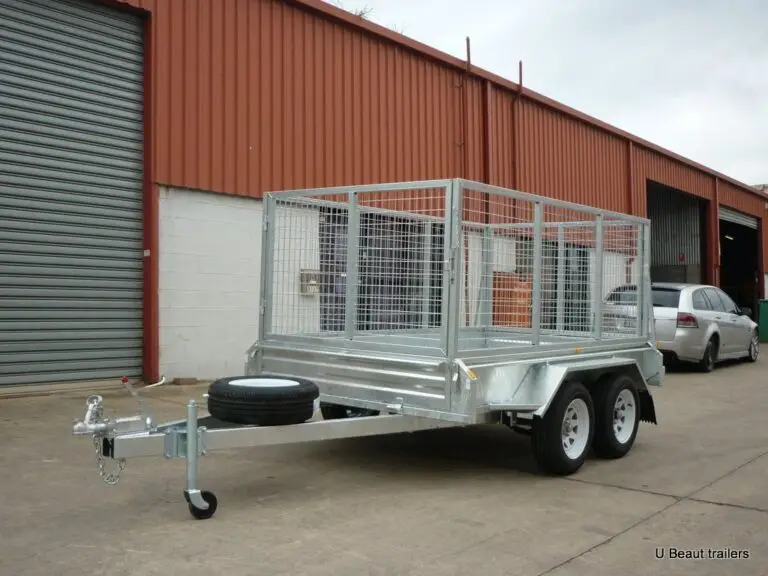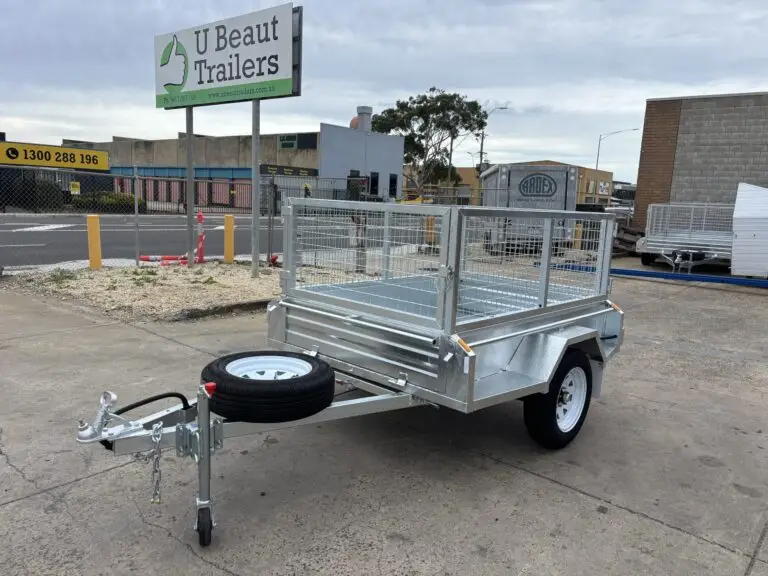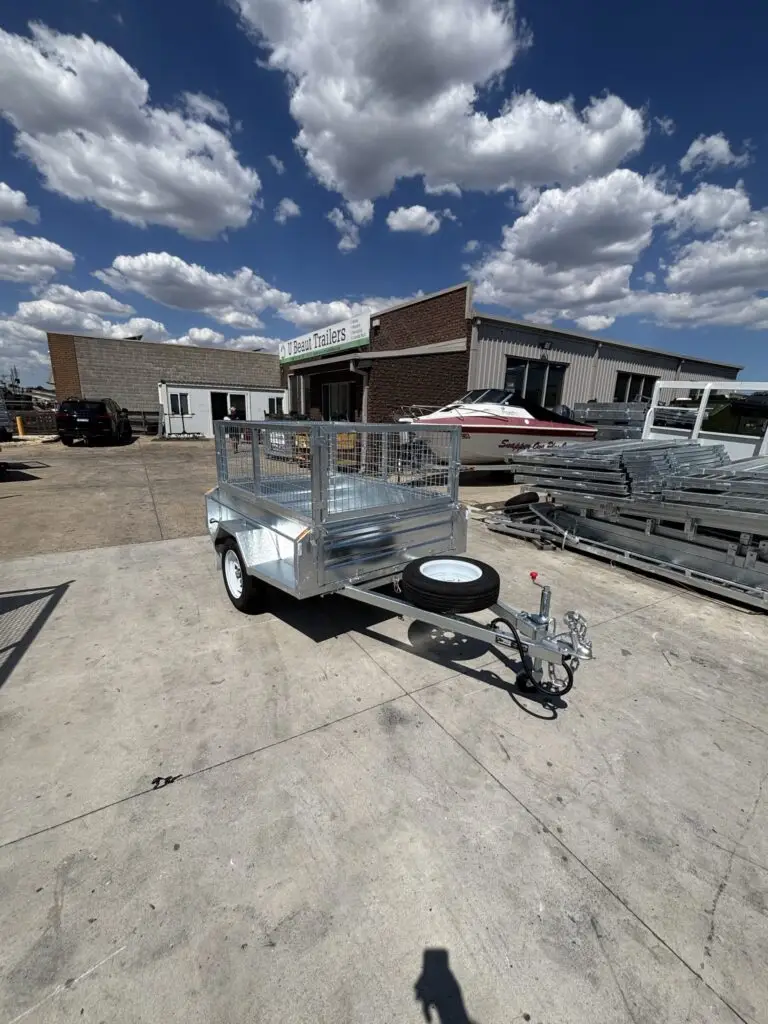
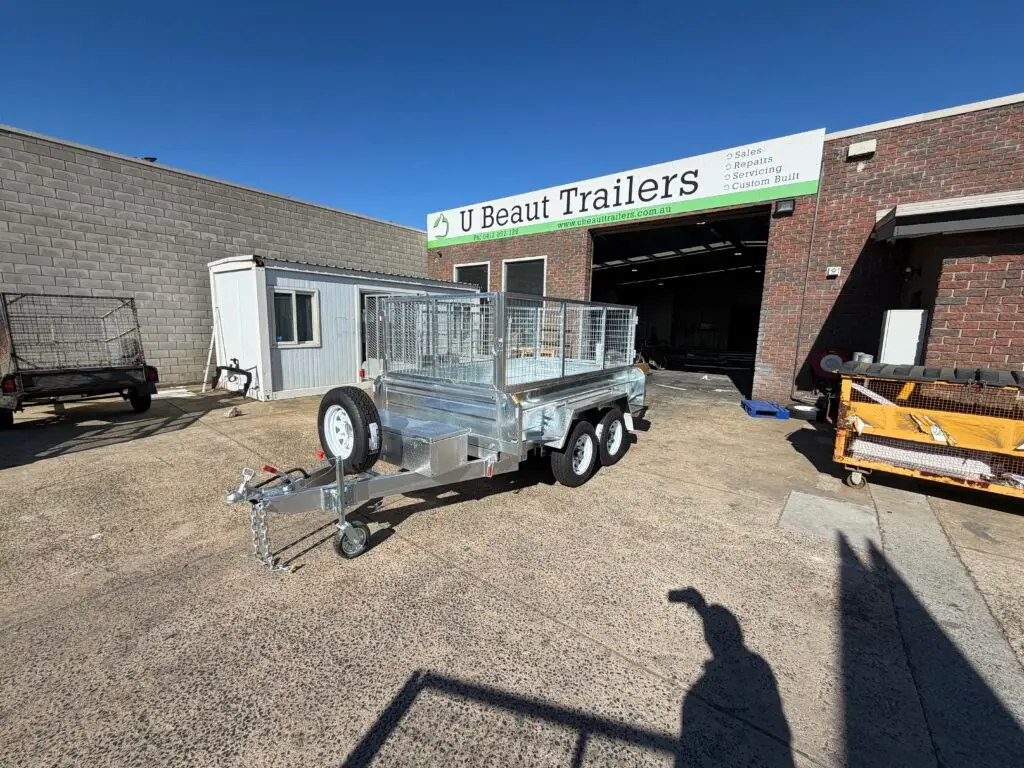
Australian trailers are sized in feet — a “6×4” is 6ft long by 4ft wide (1.83m x 1.22m). The most common sizes run from the 6×4 single-axle box up to 12×6 tandems, and the right one comes down to the weight you need to carry, measured as ATM (Aggregate Trailer Mass). Here’s every common size in feet, centimetres and metres, with its ATM and what it’s best for.
Australian trailer size & dimensions chart
| Size (ft) | L x W (cm) | L x W (m) | Axle | Max ATM | Best for |
|---|---|---|---|---|---|
| 6×4 | 183 x 122 cm | 1.83 x 1.22 m | Single | 750kg | Tip runs, garden waste, small moves |
| 7×4 | 213 x 122 cm | 2.13 x 1.22 m | Single | 750kg | A little more length, same easy towing |
| 7×5 | 213 x 152 cm | 2.13 x 1.52 m | Single | 750kg | The DIYer’s all-rounder |
| 8×5 | 244 x 152 cm | 2.44 x 1.52 m | Tandem | 2,000kg | Bigger loads, trades, moving house |
| 9×5 | 274 x 152 cm | 2.74 x 1.52 m | Tandem | 2,000kg | Construction and heavier hauls |
| 10×5 | 305 x 152 cm | 3.05 x 1.52 m | Tandem | 2,000-2,800kg | Bulk goods and long loads |
| 10×6 | 305 x 183 cm | 3.05 x 1.83 m | Tandem | 2,000-2,800kg | Plant, equipment, wider loads |
| 12×6 | 366 x 183 cm | 3.66 x 1.83 m | Tandem | 2,000-2,800kg | Serious loads – machinery and bulk |
| 12×7 | 366 x 213 cm | 3.66 x 2.13 m | Tandem | Up to 3,500kg | Flat-top and heavy tipper builds |
Dimensions are the trailer floor (deck) size. Overall length is longer once the drawbar is included, and cage or side height is quoted separately. The exact ATM for any trailer is on its compliance plate.
How to read a trailer size
Trailer sizes are quoted length x width, in feet. So a 7×5 is 7ft (2.13m) long and 5ft (1.52m) wide. Most single-axle box trailers are 4ft or 5ft wide; tandems are typically 5ft or 6ft. To convert feet to metres, multiply by 0.3048 (1ft = 30.48cm).
Size vs capacity: what ATM means
Dimensions tell you what fits; ATM tells you what you can legally carry — the trailer’s own weight plus its maximum load. Two things follow from it:
- Brakes. In Australia a trailer over 750kg ATM must have brakes. That’s why 6×4, 7×4 and 7×5 box trailers (750kg) are so popular — most cars can tow them unbraked.
- Your tow vehicle. Your car has its own braked and unbraked towing limits and a maximum towball weight. Your real limit is the lower of those and the trailer’s ATM.
Single-axle sizes — 6×4, 7×4 and 7×5
The most economical way to add carrying capacity to your car: light, easy to manoeuvre and simple to store. The 6×4 and 7×5 are the classic Aussie back-shed trailers — tip runs, garden clean-ups, shifting a fridge or mattress, weekend camping gear. Most come with a removable galvanised cage, and many are available as hydraulic tippers for easy unloading.
Tandem-axle sizes — 8×5, 9×5, 10×5 and 12×6
A second axle adds capacity and stability at highway speed. The 8×5 and 9×5 (up to 2,000kg ATM) are the workhorses for tradies, movers and builders; 10×5 and 12×6 (2,000-2,800kg) handle plant, machinery and bulk loads. Tandems are also the base for most flat-top, plant and larger tipper builds.
Trailer types and their typical sizes
Size is only half the decision — the style of trailer matters just as much. Here’s the range each type usually sits in:
- Box and cage trailers — 6×4 to 8×5. The everyday all-rounder; a cage adds height for bulky or loose loads.
- Flat-top trailers — 8×5 and up. An open deck for oversized, awkward or palletised loads.
- Tipper trailers — 7×5 to 12×7. Hydraulically raise the tray to unload soil, sand or green waste.
- Plant trailers — 10×5 to 12×6. Ramps and heavy-duty builds for mowers, mini-excavators and machinery.
- Stock trailers — 10×6 to 12×6. Ventilated, with sturdy floors for moving livestock.
- Lawn mower trailers — 7×5 to 8×5. Low-load, easy-access designs built for ride-ons.
- Car trailers and carriers — 14×7 and up, with a beavertail or ramps for loading.
- Custom and tradesman trailers — built to whatever size the job needs.
For a plain-English rundown of what each type is actually for, see our guide to the different types of trailers.
What size trailer do I need?
Work through four quick questions:
- What’s the heaviest thing you’ll carry? Match it to ATM, with a bit of headroom.
- What can your car legally tow? Check its braked and unbraked capacity and towball rating.
- Braked or unbraked? Under 750kg keeps things simple; over 750kg means brakes.
- What about next year? One size up, or adding a cage or tipper now, often saves buying twice.
As a rule of thumb: a 6×4 or 7×5 covers most household jobs; an 8×5 or 9×5 tandem suits a house move or trade work; 10×5 and up is for plant, machinery and bulk loads.
Accessories worth considering
Cages (hot-dipped galvanised and removable) let you carry high or loose loads. Loading ramps are a must for anything on wheels — mowers, bikes, machinery. Hydraulic tipper systems, usually remote-operated, take the back-breaking work out of unloading. Check out our available accessories. We can fit these at build time.
Looking after it — and keeping it road-legal
Whatever size you choose, a trailer lasts longer with a bit of care: check tyres and lights before each trip, keep the coupling and bearings greased, and give a galvanised trailer an occasional wash to clear salt and grit. Our guides to trailer maintenance, cleaning a galvanised trailer and towing safely on Australian roads cover the basics. If something needs attention, we handle trailer repairs and servicing in-house.
Built in Melbourne, made to last
U Beaut has been building trailers for more than 30 years. We manufacture in Seaford, Victoria, using high-quality steel from Bluescope Steel in Braeside and Aussie-made components wherever we can. Galvanising is done locally and our paint comes from Dulux — so your trailer stands up to Australian conditions and holds its value.
Registration made easy
U Beaut is an accredited VicRoads online dealer, so we can register your new trailer at the time of purchase — no extra trip, no extra hassle.
Not sure which size suits your job? Call the team at U Beaut Trailers on (03) 9708 2691 or get in touch and we’ll match a trailer to it.
What are the standard trailer sizes in Australia?
The common sizes are 6×4, 7×4 and 7×5 single-axle trailers (up to 750kg ATM), and 8×5, 9×5, 10×5 and 12×6 tandem trailers (2,000-2,800kg). Sizes are given in feet — length x width.
What size is an 8×5 trailer in cm and metres?
An 8×5 trailer has a floor of about 244cm x 152cm (2.44m x 1.52m) — 8ft long by 5ft wide. Overall length is a little more once the drawbar is included.
What size is a 7×5 trailer in cm?
A 7×5 trailer floor is roughly 213cm x 152cm (2.13m x 1.52m) — 7ft by 5ft.
What size is a 6×4 trailer in metres?
A 6×4 trailer floor is about 1.83m x 1.22m (183cm x 122cm) — 6ft long by 4ft wide. It’s Australia’s most popular trailer size.
What is the standard trailer width?
Most box trailers are 4ft (1.22m) or 5ft (1.52m) wide; larger tandems run to 6ft (1.83m) or 7ft (2.13m).
What size trailer can I tow without brakes?
Up to 750kg ATM can be towed without trailer brakes in Australia. Above 750kg the trailer must have a braking system — which is why 6×4 and 7×5 box trailers are so popular.
What size trailer do I need?
For everyday household jobs, a 6×4 or 7×5. For a house move or trade work, an 8×5 or 9×5 tandem. For plant, machinery or bulk loads, 10×5 and up. Match the load weight to ATM and check your vehicle’s towing limit.
How big a trailer can my car tow?
Check your vehicle’s braked and unbraked towing capacity and its maximum towball download in the handbook. Your real limit is the lower of your car’s capacity and the trailer’s ATM — never exceed either.